
- COVERS I and IV – changed color values for Blue and Yellow to match new “How to make ’em book” on title page. Text color was changed to improve readability against a darker blue background. These are working changes subject to further revision. [See PDF of the Cover Spread here]
- Page 1 – replaced scan of hardcopy “How to make ’em book” with scan of slide from Bill Bean Collection:
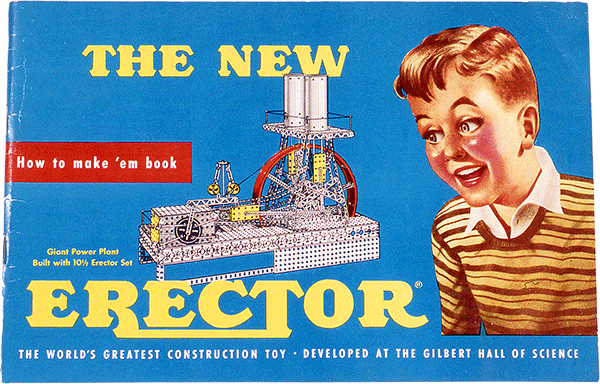
- Page 2 – Revised caption:
Page 1: Cover from a “How to make ‘em book” for The New Erector, from the collection of William M. Bean.
ACKNOWLEDGEMENTS
- Page 4 – Added name Frank Merrill to Paragraph 5 and 6; revised Paragraph 4:
Another Society member whose contributions to this guide were indispensable is Michael Foster. Michael went above and beyond the call of duty to furnish more than three dozen photographs of Erector sets and component parts. We couldn't have produced this revision without him.
CHAPTER 1
- Page 18 – Paragraph 4, Line 3, changed: “(MD) Flat Plate” to “(ME) Flat Plate”
- Page 19 – Paragraph 1 under Cardboard Box Sets, Line 4, changed: “Style 1” to “Type 1”
- Page 20 – Paragraph 3, Line 1, changed: “red (LW) 3-inch” to “red (LV) 3-inch”
- Page 21 – Paragraph 2, Line 3, changed: “middle-of-theline” to “middle-of-the-line”
- Page 22 – Paragraph 3, Line 1, changed: “Mounted via four metal tabs welded to the lid was a large, colorful display insert made of heavy cardboard” to “Mounted on the lid was a large, colorful display insert made from heavy cardboard”
- Page 30 – Paragraph 3, Line 3, changed: “although Hudson sets from 1933” to “although the Hudson sets from 1933”
- Page 30 – Paragraph 4, Line 5, changed: “The (LW) tires were designed to be used with the (LV) 3-inch Disc Wheels, Red; these wheels and tires are discussed at length later in this chapter.” to “The (LW) tires were designed to be used with the red (LV) 3-inch Disc Wheels. These wheels and tires are discussed at length later in this chapter.”
- Page 31 – Revised caption (see note on Page 37 under Modified Parts for the (T) Boiler):
Boilers from early 1934 (right) came with a gold background decal that had been used since 1928. Starting in late 1934, the boilers came with the same red-lettered decal used on the cab of the Hudson locomotive, including the one of the left which dates from 1960-1962. (Michael Foster Collection)
- Page 31 – Paragraph 3, Line 3, changed: “came with a pow der blue body” to “came with a powder blue body”
- Page 33 – Paragraph 1, Line 2, changed: “box painted red” to “red metal box”
- Page 34 – Paragraph 3, Line 4, changed: “the set seems half gone” to “the set seems half empty”
- Page 34 – Revised caption:
Beginning in 1934 and continuing through 1937, the Hudson locomotive and tender sets came in a huge metal box. The powder blue metal box and tray were unique to the version from 1934 (pictured above). The locomotive and tender were packed in Set No. 9½ in 1935, and in No. 10½ in 1936 and 1937. Note the deterioration of the (LW) Rubber Tires mounted on the inside lid in the 1934 set pictured here. The chemical formula used for these tires has not withstood the test of time. (William M. Bean Collection)
- Page 35 – Paragraph 3, Line 7, changed: “picture of two boys and Hudson crossing a bridge made of Erector” to “picture of two boys and a Hudson crossing a bridge made of Erector”
- Page 35 – Revised caption to reflect text in book:
Beginning in 1934, the disc wheels that Gilbert included in different sets can be confusing. Top: (left) the (LV) 3-inch Disc Wheel, Red, which came in Set Nos. 3, 4, and 6; and (right) the (MH) 3-inch Disc Wheel, Nickel Rim, which was included in Set No. 7. (Michael Foster Collection) Above: a pair of (LV) wheels with the (LW) Rubber Tires, which were packed in only the most expensive sets, Nos. 7½ and 8. (Charles Bisek Collection)
- Page 37 – Under description of No. 6 – The Super 6, changed: “featured 110-volt (P56G) Motor and Boiler.” to “featured 110-volt (P56G) Motor and (T) Boiler.”
- Page 39 – Paragraph 3, last line, changed: the Skyscraper Set to “The Erector Skyscraper Set” with quotation marks
- Page 41 – Bottom Paragraph, first line, changed: “a curious variation related to the outer lid label used on the metal box sets” to “a curious variation occurred on the outer lid label used on the metal box sets”
- Page 42 – Paragraph 2, middle of paragraph, added quotation marks to “The Erector Skyscraper Set.” Last line of paragraph, changed: “unique cardboard insert glued to bottom of the box” to “unique cardboard insert glued to the bottom of the box”
- Page 43 – Paragraph 1, Line 1, added quotation marks to “The Erector Skyscraper Set”. Last line of paragraph, changed: “The No. S is one of the most coveted Erector sets by collectors because it is rare and unique” to “Set No. S is coveted by Erector collectors because it is rare and unique”
- Page 46 – Under An Aside…, Paragraph 2, Line 3, changed: “One with a reversing toggle switch mounted on the rear of the motor housing came in the largest sets (Nos. 8½ and 9½)” to “One version, which came with the largest sets (Nos. 8½ and 9½), had a reversing toggle switch mounted on the rear of the motor housing”
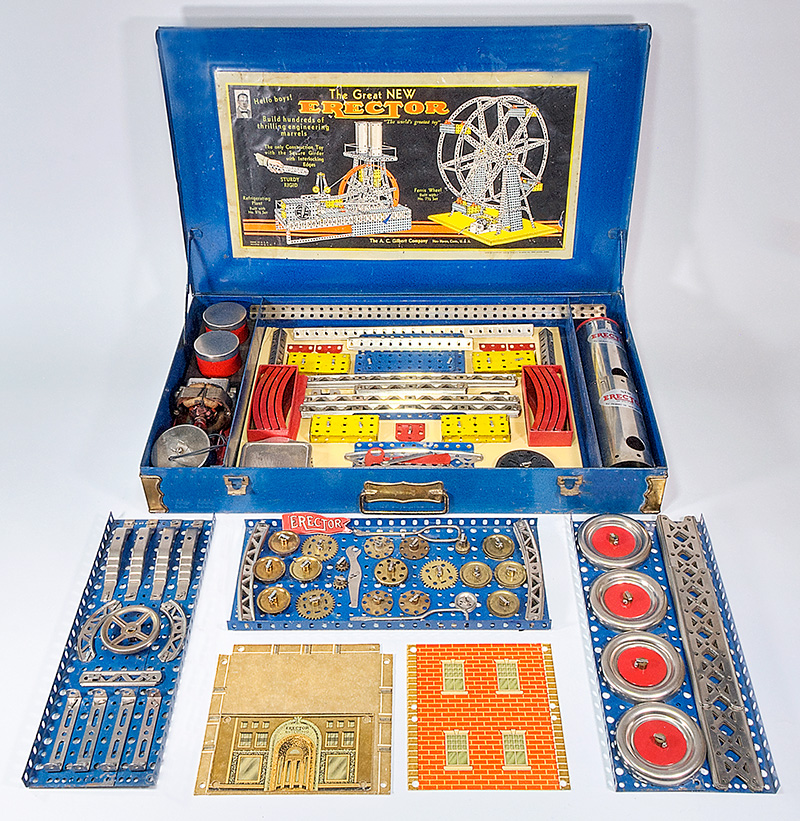
- Page 47 – New photograph and caption:
- Page 48 – First line, changed: “At the same time engineers were developing the (P51), others…” to “At the same time engineers were developing the (P51) Electric Engine, others…” (this fixes the hyphenation of “Gilbert”)
- Page 49 – Under I. New Parts, inserted: “(NE) 6-inch Garage Entrance” after “(ND) 6-inch Upper Story”
- Page 50 – Under No. 7½ – The Engineer’s Set, changed: “hoisting drum” to “(MR) Drum with Gear”
- Page 53 – Revised caption:
1937 No. SA, “The Skyscraper Accessory Set.” This Accessory Set had its own lithographed box cover. Despite the introduction of a new concept and new product, the set was dropped at the end of 1937. (Dave Blood Collection)
- Page 54 – Last Paragraph, Line 3: added quotation marks to “The Automotive Set”
- Page 55 – Revised caption:
Gilbert offered the Erector Hudson for the last time in 1937 as Set No. 10½. It contained all the regular parts from No. 9½ along with the train parts. Set No. 10½—along with the 1936-1937 No. 7½—were packed in a royal blue box, a color unique to these two metal box sets. (William M. Bean Collection, Kalmbach Publishing Company photograph)
- Page 56 – Under I. New Parts, inserted: “(P7A) 1 1/8-inch pulley (1937)” after “(P7) 7/8-inch Pulley (1937)”
- Page 57 – Under No. 8½ – The Engineer’s Set, changed: “hoisting drum” to “(MR) Drum with Gear”
- Page 58 – Second column, revised set title: No. SA (1937) – The Skyscraper Accessory Set; changed last sentence from: “Came in a cardboard box of unknown size” to “Came in a cardboard box 18¼” x 10¼” x ¾” “
CHAPTER 2
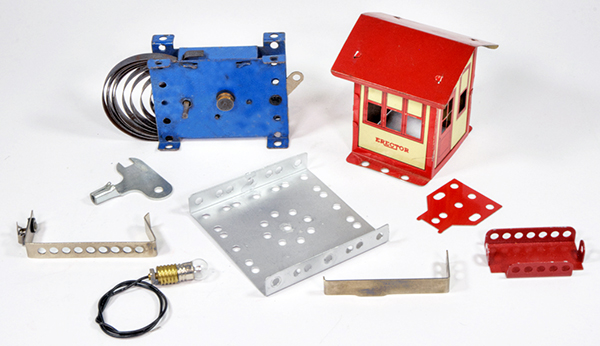
- Page 59 – revised photo and updated caption:
- Page 61 – last paragraph, first sentence, changed: “Late in 1939 things changed, and the duplex standardization was dropped. The (MN) Base Plate came with all small holes” to “The change took place in late 1939, when the duplex standardization was dropped and the (MN) Base Plate came with all small holes”
- Page 61 – Revised caption:
Top: The (A49) Electric Engine was introduced in 1938. The model illustrated here includes a gearbox guard across the top of the engine, which was added in 1939. During this engine’s twenty-six-year history, it was continually modified and improved. (David T. Gilbert Collection)
- Page 62 – first paragraph, last sentence, changed: “The most significant aspect of No. 4½ was its being the only cardboard box set to include the (A48) Mechanical Motor” to “The most significant change to Set No. 4½ was the addition of the (A48) Mechanical Motor—the only cardboard box set to include this new item”
- Page 64 – Revised caption:
In 1938, No. 6½ was the smallest set to contain the new Electric Engine. Note the complicated assortment of cardboard inserts used for packing this set. The set pictured here shows the (A49) Electric Engine with a thin metal red gearbox guard across the top, which dates to 1939. (Michael Foster Collection)
- Page 65 – last paragraph, Line 6, changed: “which housed the boiler” to “which housed the (T) Boiler”
- Page 68 – second paragraph, Line 1: added quotation marks to “The Electric Train Set”
- Page 69 – under The Electric Train Set of 1939: added quotation marks to “The Electric Train Set”
- Page 73 – under description of No. 4½ – The Famous No. 4½, changed: “Featured the (A48) Mechanical Motor and (MN) 12-inch Base Plates, and (MX) House and built truck with (A48); model pictured on inside lid label” to “Featured the (A48) Mechanical Motor, (MN) 12-inch Base Plates, and (MX) House and built the truck model with the (A48) Mechanical Motor (pictured on inside lid label).”
- Page 76 – top of page, changed: “Inspired by the Parachute Jump Ride at the 1939 World’s, Fair in New York” to “Inspired by the Parachute Jump Ride at the 1939 World’s Fair in New York” Last sentence in same paragraph, added quotation marks to “The Automotive Set” and “The Electric Train Set”
- Page 77 – last paragraph, first line: added quotation marks to “The Electric Train Set.”
- Page 78 – Footnote 7, changed: “S scale” to “S gauge”
- Page 81 – Inserted under section IV: “(M) Small Double Angle” between “All Big Channel Girders: (EX), (EY), (EZ)” and above “(DK) Flat Spring”
- Page 82 – under description of No. 4½ – The Famous No. 4½, changed: “Featured the (A48) Mechanical Motor and (MN) 12-inch Base Plates, and (MX) House and built truck with (A48); model pictured on inside lid label” to “Featured the (A48) Mechanical Motor, (MN) 12-inch Base Plates, and (MX) House and built the truck model with the (A48) Mechanical Motor (pictured on inside lid label)”
- Pages 86-87 – Revised dimensions of box for Erector Junior No. 3 to 18″ x 10″ x 1½” and No. 5 to 20½” x 13⅜” x 1½” on pages 86 and 87. (Hansen)
CHAPTER 3
- Page 89 – Paragraph 3, Line 5, changed: “one that has controlled the direction of the American economy since 1945” to “one that controlled the direction of the American economy after 1945”
- Page 95 – under set title No. 7½ – The Engineer’s Set, changed: “two-layer set with two removable cardboard parts display tray” to “two-layer set with two removable cardboard parts display trays”
- Page 97 – Revised caption:
Although still packed in a cardboard box, No. 7½ from 1947 (pictured here) came in a red cardboard box while the 1946 version came in a blue cardboard box. (William M. Bean Collection, Kalmbach Publishing Company photograph)
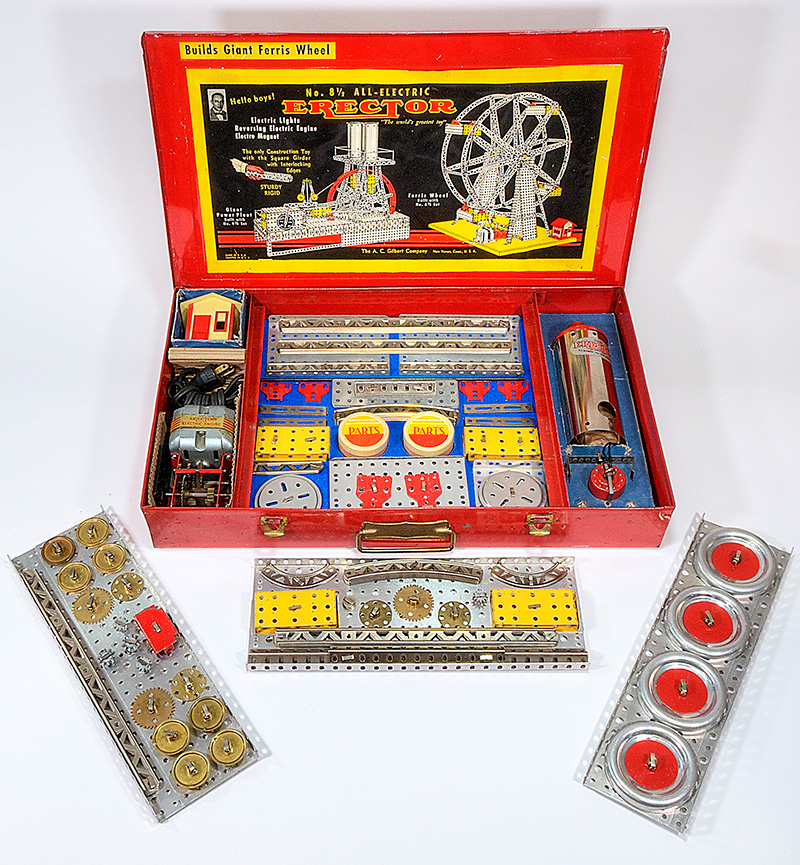
- Page 99 – Page 99, new photograph by Michael Foster and new caption:
- Page 101 – Column 2, half-way down page, changed: “(MR) Radiator” to “(MA) Radiator”
- Page 103 – Second to last line, changed: “All and all…” to “All in all…”
- Page 106 – Under Erector System Modifications and all instances after (including Contents Lists), changed: “(2-B) Transformer” to “(2B) Transformer”
- Page 109 – Paragraph 6, Line 1, changed: “the (NT) Corie” to “the (NT) Cone”
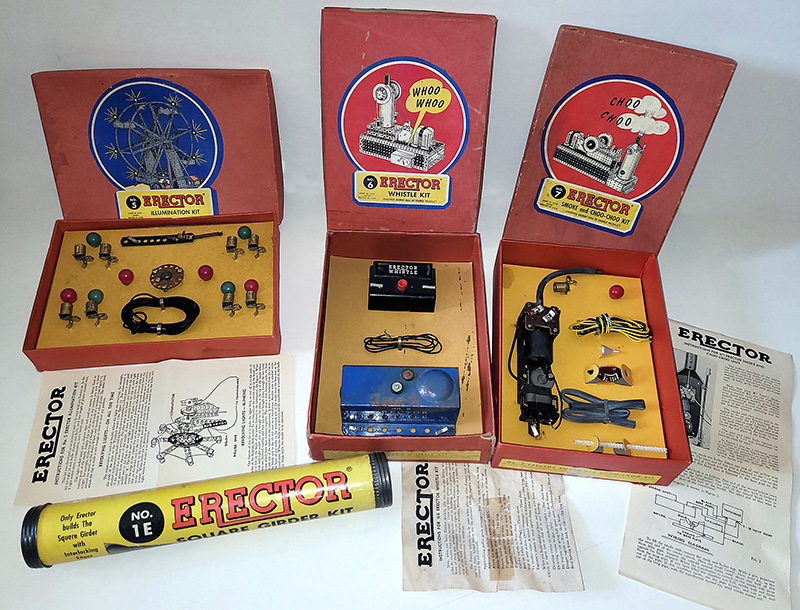
- Page 111 – Replaced 1949 Accessory Sets photo by Bill Bean with new photo by Bruce Hansen:
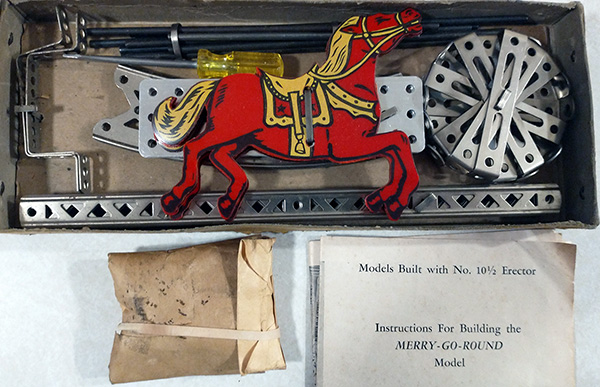
- Page 112 – Because the new 1949 Accessory Sets photo above took up less space on page 111, I had room on Page 112 to enlarge photo of 1949 No. 12½A Accessory Kit by Ken Schuman:
- Page 114 – Paragraph 2, Line 2 under Metal Box Sets, changed: “cardboard boxed No. 6½” to “cardboard-boxed No. 6½”
- Page 115 – Paragraph 1, Line 3, changed: “cataloged” to “catalogued” (we have used “catalogued” throughout the guide)
- Page 122 – Paragraph 6, Line 1, changed: “The whistle kit was a companion to No. 5 and packaged similarly” to “The whistle kit was a companion to No. 5, “The Erector Illumination Kit,” and packaged similarly”
- Page 125 – Under set title No. IE (1949-1950) – The Square Girder Kit, changed: “Featured extra 5-inch and 10-inch straight girders” to “Featured extra (B) 5-inch Girders and (C) 10-inch Girders”
- Page 127 – Last paragraph, Line 1, changed: “(OH) Horse” to “(OF) Horse”
- Page 127 – Last paragraph, last line, changed: “than their plastic counterparts and harder to find in good condition” to “than their plastic counterparts and are harder to find in good condition”
- Page 130, Column 1, Line 6, corrected typo from original book:
Removed (E) as (E) is a girder, not a strip
- Page 130 – Column 1, changed: “(EL) Gear Box Side Plate” to “(EI) Gear Box Side Plate”
- Page 130 – Column 2 under Modified Parts, changed: “(OG) Horse” to “(OF) Horse”
- Page 130 – Under Eliminated Parts, changed: “(No. 5) Transformer” to “(No. 1) Transformer”
- Page 130, bottom table of Sets for 1950-1956:
Changed "1953-19548" to "1953-1954" and deleted double instance of "No. 2½" immediately below
- Page 132 – Paragraph 1, last sentence: added quotation marks to “The Erector Whistle Kit.”
- Page 133 – Page 133 – Replaced Bill Bean photo with Michael Foster photo and updated caption:
Set Nos. 4½ (right) and 6½ (left) from 1954-1955 were packed in cardboard boxes. No. 4½ featured the (A48) Mechanical Motor, while No. 6½ came with the (A47) Electrical Engine. (Michael Foster Collection)
- Page 135 – Paragraph 2, last sentence, changed: “(BT) Turret Plate” to “(BN) Turret Plate”
- Page 139 – Paragraph 1 under The 1954 Erector Line, Line 3, changed: “ceding management of the company to his son, A. C. Gilbert, Jr.” to “ceding day-to-day management of the company to his son, A. C. Gilbert, Jr.” (there is ample evidence that A. C. as Chairman of the Board continued to influence the company)
- Page 139 – Paragraph 43, Line 1, changed: “A minor change occurred with the cover of the instruction manual cover” to “A minor change occurred with the cover of the instruction manual”
- Page 139 – Last paragraph, second to last line, changed: “This caused a great deal of frustration for collectors…” to “This has caused a great deal of frustration for collectors…”
- Page 140 – Revised caption:
Set No. 6½ “All-Electric” from May 1954. The (A49) Electric Engine was reintroduced to the Erector line this year. The motor housing was painted a distinctive blue-gray, and the core decal previously affixed to the gearbox guard with the words “Erector Electric Engine” was dropped from these motors for most of 1954. (Jay Goldstein Collection)
- Page 141 – Revised caption:
Set No. 7½ “Engineer’s Set” from August 1954. The version of the (A49) Electric Engine pictured here shows the new decal affixed to the gearbox guard, “Erector Electric Engine,” featuring black lettering on a yellow background. (Jay Goldstein Collection)
- Page 142 – First paragraph, last line under The 1955 Erector Line, changed: “the lineup after being gone since 1942” to “the lineup after being absent since 1942”
- Page 144 – Last paragraph, Line 2, changed: “but the color of paper used to cover the body of the box…” to “but the color of paper used to cover the body of the cardboard box…”
- Page 148 – Paragraph 3, Line 6: added quotation marks to “The Remote Control Set” and “The Master Builder Set”
- Page 148 – Second to last paragraph, Line 3, changed: “It was not even given a part designation until 1958, when it was denoted on the Separate Parts Order Form as (X14B663) Bucket” to “It was not even given a part designation until 1959, when it was denoted on the new Gilbert Erector Separate Parts Order Form as (X14B663) Bucket” (I cannot find (X14B663) Bucket on the 1958 Separate Parts Order Form, page 175; first shows up on Form M4630 from 1959, page 183)
- Page 151 – Under New Parts, changed: “Clam Shell Bucket, no part designation until 1958” to “Clam Shell Bucket, no part designation until 1959”
- Page 153, under No 10½, changed: “19551” to “1955” in last sentence.
CHAPTER 4
- Page 157 – Revised caption (Hansen):
This scarce No. 16010 from 1957, the smallest catalogued set from the Post-Renaissance Period, contained a host of uncatalogued parts. A second variation of this set from 1957 had the same parts but a different layout. (Dan Yett Collection, Kalmbach Publishing Company photograph)
- Page 159 – Paragraph 3, Line 6, changed: “The two styles were even mixed in some sets, such as new-style 10-inch Girders (C) and old-style 5-inch Girders (D). But a particular type of girder was never mixed in a set, such as both old and new 10-inch (C) girders” to “The two styles were even mixed in some sets, such as new-style (C) 10-inch Girders and old-style (D) 5-inch Girders. But a particular type of girder was never mixed in a set, such as both old and new (C) 10-inch Girders”
- Page 160 – Paragraph 1, Line 2, changed: “There were four 1½-inch-diameter blue plastic wheels with “Erector” embossed on them.” to “Two versions of No. 16010 were produced; the earliest version came with four 1½-inch diameter black plastic wheels. The later version came with four 1½-inch diameter blue plastic wheels with “ERECTOR” embossed on them.”
- Page 160 – Paragraph 1, Line 3, changed: “The set also contained a 5½” x 2″ red-painted base plate, a part last used in Nos. 0 and 00 in the 1920s, at which time it was known as (FO) Double Angle Base Plate.” to “The set also contained a 5½” x 2″ red-painted base plate, previously known as (FO) Double Angle Base Plate. This part was used in the 1920s in Set Nos. 0, 00, 000, and was last used in 1952 Set No. 0.”
- Page 160 – Paragraph 3, Line 4, changed: “It was old No. 6½, but in a cardboard box. What makes this set a curiosity is not just that Gilbert offered the old No. 6½ in both a cardboard and a metal box, but that a smaller metal box set, No. 5½, was not available with the same options. The cardboard version of old No. 6½ sold for $2.00 less than the metal box version” to “It was the same set as 1956 No. 6½, but in a cardboard box rather than a metal box. What makes this set a curiosity is not just that Gilbert offered Set No. 6½ in 1957 in both a cardboard box (No. 10046) and a metal box (No. 10051), but that a smaller metal box set, No. 5½, was not available with the same two options. The cardboard version of 1957 No. 6½ sold for $2.00 less than the metal box version”
- Page 160 – Under Metal Box Sets, Paragraph 1, last line, changed: “For use with the new (DC3) Motor were two (NJ) Battery Holders, some wire, and a second (DB) Motor Pulley” to “Two (NJ) Battery Holders, some wire, and a second (DB) Motor Pulley were furnished for use with the new (DC3) Motor”
- Page 161 – Paragraph 4, Line 2, changed: “cataloged” to “catalogued”
- Page 164 – Replaced photo of 3 rockets with photo of 4 rockets with Michael Foster photo and updated photo caption:
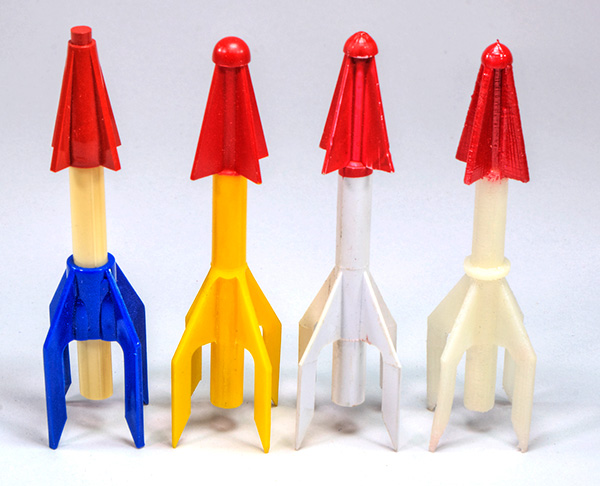
- Page 164 – Revised paragraph #1 to more accurately reflect provenance of Erector rockets:
New parts were introduced into the Erector System in 1958. Building upon the space theme, the (P14A686) Rocket was included in No. 10052 and larger sets. Four variations of this plastic rocket appeared over the next few years—two of them specific to 1958. The earliest version had a white body, blue tail fins, and a red nose cone. Each piece was cast separately and then assembled into the finished rocket. By the end of 1958, a less costly manufacturing technique was used: the entire rocket was cast from a single piece of yellow plastic, with the nose cone painted red. Beginning in 1959 and during most of 1960, the rocket was made from white plastic instead of yellow plastic—with the same red nose cone—creating a third variation of this part. In late 1960 until the end of traditional Erector production in 1962, a fourth variation was introduced when a molded ring was added above the fins.
- Page 164 – Paragraph 3, Line 5, changed: “smashed” to “stuffed”
- Page 164 – Last sentence spanning both pages, changed: “one side offered carnival music for use with the amusement park models and the other choo choo sounds for use with steam-engine models” to “one side offered carnival music for use with the amusement park models and the other side offered choo choo sounds for use with steam-engine models”
- Page 164 – Revised footnote 3:
Correspondence with A. C. Gilbert Heritage Society members Peter Hobday (June 23, 2022) and Bruce Hansen (September 29, 2022).
- Page 165, revised caption to more accurately describe what the photo depicts:
1958 No. 10031 Engineer’s Set (center) and the “tube” sets from 1958-1959: No. 10011 Beginner’s Set, No. 10021 Young Builder’s Set, and No. 10032 Engineer’s Set. This was the last year for cardboard box sets and the first for tube sets. The cardboard box sets from 1958 are the only ones adorned with this kind of artwork. (William M. Bean Collection)
Page 167 – Added new photo to top right corner of page with tear in cover repaired and added caption:
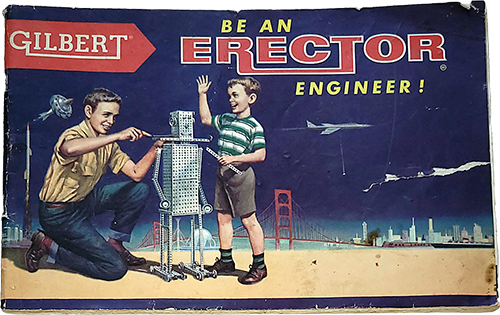
- Page 167 – Paragraph 3, Line 2, changed: “But it was dropped in 1958” to “But it was dropped sometime in 1958”
- Page 169 – Paragraph 2, Line 3, changed: “(FPX239)” to “FP(X239)” (with no spaces). I also corrected all occurrences of this part number on the following pages, including all Contents Lists.
- Page 171 – Paragraph 3, first line, changed: “Changes in packaging were made similar to the larger metal box sets” to “Changes made to the packaging of No. 10062 were similar to the changes made in the larger metal box sets”
- Page 171, revised caption:
1958 No. 10072, the first version of “The Musical Ferris Wheel Set,” is a favorite among collectors. The complicated arrangement of cardboard display inserts makes this a superb display set. (Michael Foster Collection)
- Page 172 – Paragraph 3, Line 1: added quotation marks and capitalized all words of “The Musical Ferris Wheel Set”
- Page 175 – Column 2, corrected set title: “No. 10972 – The Musical Ferris Wheel Set” to “No. 10072 – The Musical Ferris Wheel Set”
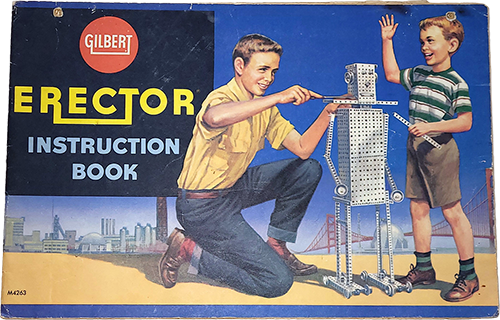
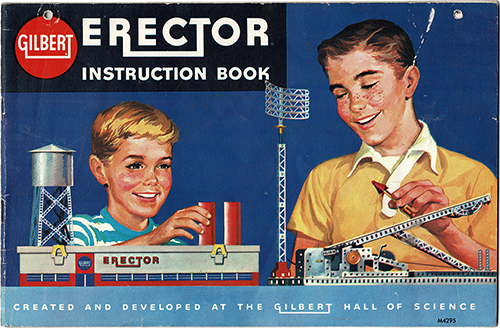
- Page 178 – Added new photos of M4263 and M4295 and revised the caption:
- Page 182 – Revised caption:
Front side of “Gilbert Erector Separate Parts Order Form” M4630 from 1960. (Courtesy of Peter Hobday)
- Page 183 – Revised caption:
Back side of “Gilbert Erector Separate Parts Order Form” M4630 from 1960. (Courtesy of Peter Hobday)
- Page 184 – Revised caption:
In 1959, Gilbert chose Set No. 10053, “The Rocket Launcher Set,” to commemorate the 50th Anniversary of the company. Below: Note the unique label on the outside box lid of this special set. Opposite Page: A cardboard display insert, which covers the entire inside lid, has four slots to hold the instruction manual in place. (Peter Hobday Collection, David T. Gilbert photographs)
- Page 187 – New photo of 1959 No. 10073 furnished by Michael Foster.
- Page 190 – Moved photo of set box for No. 10084 from Page 192 to this page, re-flowing text as necessary
- Page 191 – Updated “Space Age Erector” paragraph by adding set numbers to the text:
Major revisions were made with Space Age Erector in 1960. When this system was introduced in 1959, only one set was offered, and it came in a cardboard box (No. 18000). Now the line was expanded to four sets, and they all came in tubes that were capped with a blue, plastic “nose-cone” that made the container look like a rocket (Nos. 18010, 18020, 18030, and 18040). This nose-cone had a slot so it could serve as a display base for the models. The black plastic display base offered with the set in 1959 was dropped.
- Page 192 – Added photo of “Space Age Erector” sets from Frank Merrill Collection, re-flowing text as necessary

- Page 192 – Removed text “(Correspondence with Bruce Hansen, July 24, 2022.)” from footnote 9 and 10, as these statements of fact do not in my opinion require a source
- Page 193 – Moved photo of 1961 No. 10053 from Page 194 to this page, replacing photo of 1960 No. 10094; replaced photo of 1961 No. 10053 to show correct parts lid; “cleaned up” rust residue around gears in front center of top tray.
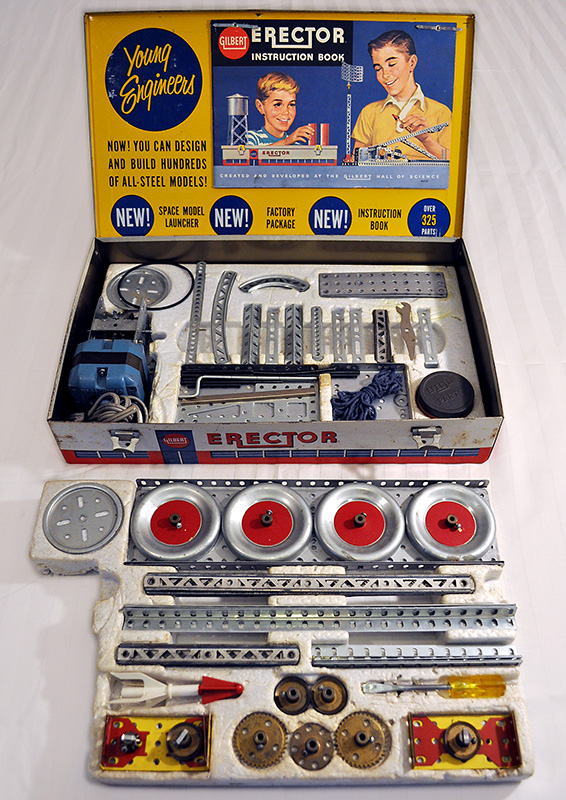
- Page 193 – Paragraph 2, Line 7: Started a new paragraph with “Incidentally” and changed “even though the model had been revised in 1949, the old version had been pictured on the inner lid label of the old set box” to “even though the model had been revised in 1949, a picture of the old model still appeared on the inner lid label of the set box”
- Page 195 – Moved photo of 1960 No. 10094 to this page, re-flowing text as necessary
- Page 195 – Paragraph 2, Line 1, changed: “As with No. 10084, “The Master Builder Set” was partitioned” to “As with No. 10084, “The Master Builder Set” (No. 10094) was partitioned”
- Page 195 (moved to Page 196) – Paragraph 3, Line 2, changed: “In 1960, the Rocket Launcher Set box was lithographed” to “In 1960, the box for “The Rocket Launcher Set” was lithographed”
- Page 197 – Under No. 10094 – The Master Builder Set, changed: “Two-layer set in right compartment with removable Styrofoam® parts tray; one-layer set in left compartment with cardboard dividers” to “Two-layer set in left compartment with removable Styrofoam® parts tray; one-layer set in right compartment with cardboard dividers” (This is consistent with the photo of Set No. 10094 on Page 193). Added footnote: “The catalog shows the removable Styrofoam® parts tray on the right.”
- Page 198 – Paragraph 3, Line 1, changed: “Almost every set in the lineup came with a new name in 1962” to “Almost every set in the 1962 lineup came with a new name”
- Page 200 – Paragraph 7, Line 1, changed: “Six new models” to “Seven new models”
- Page 200 – Paragraph 7, added sentence to end of paragraph: “The Master Builder Set” included instructions for building the Space Needle, a model based on the iconic attraction at the1962 Seattle World’s Fair.
- Page 200 – Paragraph 8, Line 1, changed: comma [,] to period [.] after “1962”; deleted last sentence in paragraph: “Other oddities include some blue-handled screw drivers and occasional blue hooks instead of yellow hooks.” And deleted footnote 14.
- Page 203 – Under set title No. 10231 – The Astronaut Set, Line 5, changed: “Astronaut Train” to “Astronaut Trainer”
- Page 203 – Under No. 10094 – The Master Builder Set, last sentence, changed: “Two-layer set in right compartment with removable Styrofoam® parts display tray; one-layer set in left compartment with cardboard dividers” to “Two-layer set in left compartment with removable Styrofoam® parts tray; one-layer set in right compartment with cardboard dividers”
CHAPTER 5
Page 205 – Paragraph 2, revised last sentence and added footnote:
The line of these sets was expanded in 1934, but in 1935 the cardboard inner lid parts displays gave way to inner lid labels on most of the sets as Gilbert continued to develop the regular Erector line.
[FOOTNOTE] In the regular Erector line, 1935 Set No. 9½ (the Hudson set) retained the inner lid parts display, as did the Hudson sets in 1936 and 1937. The No. 10½ Electric Train sets from 1938-1942 also had inner lid parts displays.
- Page 206 – Paragraph 1, Line 5, changed: “instead of yellow and blue as was the regular line in 1935” to “instead of yellow and blue as they were in the regular line in 1935”
- Page 206 – Paragraph 2, Lines 5 and 6: Added quotation marks to “The Automotive Set” and “The Giant Power Plant Set”
- Page 210 – Paragraph 4, Line 2: deleted extra space before “The 1938 catalog…”
- Page 210 – Under Sears Erector Sets chart, under 1939 column, changed: “No. 9½” to “No. 9” (per re-write of chapter by Bruce Hansen)
- Page 211 – In the footnote, added quotation marks to “Amusement Park Set”
- Page 212 – Under Contents Equivalency Chart: deleted “No. 9½ (1939)” line (per re-write of chapter by Bruce Hansen)
- Page 213 – Last sentence under The 1946 Sears Erector Line, changed: “cataloged” to “catalogued”
- Page 216-217 – Added subhead titles “Science-Career Series” and “American Science Series” to the respective sections of the text
- Page 217 – Description of No. 10044 – The Automatic Radar Scope Set, first sentence:
Featured the (DC3) 3-Volt Motor and either the (P15B528) Remote Control or (NJ) battery holders.
- Page 218 – Under Contents Lists: removed “No. 8½” line (per re-write of chapter by Bruce Hansen)
APPENDIX
- Page 239 – changed “2-B Transformer” to “2B Transformer”
- Page 258 – Added “1959, 1960, 1961 SPACE AGE ERECTOR CONTENTS LIST”, placing it after 1960-1961 sets and before 1962 sets
- Page 262 – Added Bibliography above Revision History